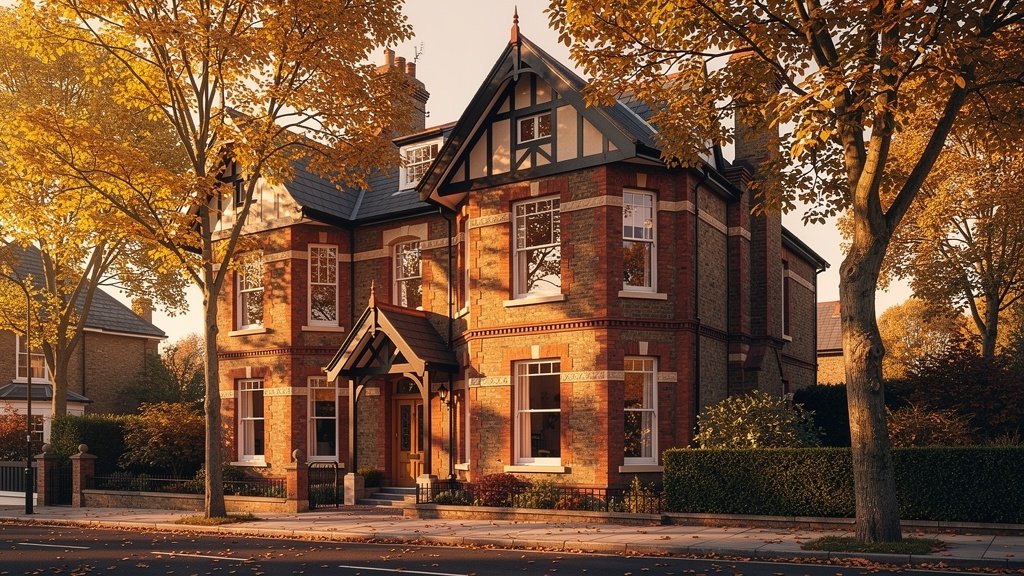
Bedford Park holds a special place in the hearts of people who know Chiswick well — and in the hearts of Chiswick Surveyors. It's one of those rare places where you round a corner and feel, for a moment, that you've stepped back into a different era. The red brick, the terracotta tile hanging, the timber-framed porches, the overhanging eaves — there's nothing quite like it in London.
But buying in Bedford Park comes with a distinct set of considerations that a non-specialist surveyor might miss entirely. As someone who's carried out dozens of surveys in this conservation area over the years, I want to share everything you need to know before you buy.
What Makes Bedford Park Unique?
Bedford Park was developed between 1875 and 1886 as one of the world's first planned garden suburbs. It was designed by a series of eminent architects — most notably Norman Shaw, E.J. May, and E.W. Godwin — working in the newly fashionable Queen Anne Revival and Arts and Crafts styles. The result is a remarkably coherent, picturesque estate of predominantly detached and semi-detached houses set in generous tree-lined streets.
The Bedford Park Conservation Area was designated in 1967 and covers roughly the area bounded by Bath Road, Acton Lane, Chiswick High Road and Woodstock Road. Properties within the conservation area are subject to additional planning controls — even permitted development rights are curtailed — and changes to the external appearance require careful management to secure planning consent.
What Makes Surveying Bedford Park Properties Different?
1. Non-Standard Construction
Bedford Park houses were built using construction techniques and materials that were typical of the late Victorian period but are very different from modern buildings. The walls are typically solid brick — no cavity — which means they don't have the same moisture management mechanisms as modern cavity-wall construction. The original lime mortar is softer than the brickwork, which is intentional: it allows for minor movement and lets the wall breathe. Repointing with modern hard cement mortar (as has been done to many properties) can cause serious long-term damage.
2. Tile Hanging and Timber Details
Many Bedford Park houses feature decorative tile hanging on the upper elevations — original terracotta or clay tiles that can be 140 years old. When these are in good condition, they're beautiful and highly effective. When they fail — when individual tiles crack, slip or come away — they can allow water penetration that causes damage to the timber framework behind. I always pay particular attention to the condition of tile hanging in my surveys here.
3. Timber Porches and Joinery
The elaborate timber porches, bargeboards and decorative joinery that characterise these houses require regular painting and maintenance. Neglected joinery can allow water ingress and timber decay that, if unchecked, becomes structurally significant. In a Level 3 survey, I inspect every accessible timber element — not just the obvious ones.
4. Large Mature Trees
Bedford Park's leafy character comes at a price: the mature trees that line its streets can affect the foundations of older properties through root activity. Many of the streets are underlain by London Clay, which is susceptible to shrinkage and swelling with changes in moisture content. Tree roots can accelerate drying in summer, causing clay shrinkage and differential settlement in the foundations.
5. Conservation Area Constraints
Buying within the conservation area means you need to understand what you can and can't do to the property. Replacing original windows with double-glazed UPVC units, for example, is likely to require planning permission and may be refused. Original features like sash windows and traditional roofing materials must typically be retained or replaced like-for-like. These constraints are part of what makes Bedford Park beautiful — but they should inform your renovation plans and budget.
What to Look for Before You Buy
Based on my surveys in Bedford Park, here are the issues I encounter most frequently:
- Pointing repointed in hard cement: Look for grey, hard pointing with white efflorescence around it, suggesting cement mortar has been used. This can trap moisture in the brickwork and accelerate deterioration of the bricks themselves.
- Roof condition: Original clay plain tiles can last 100 years or more if well-maintained, but often need periodic tile replacement. Flat roof sections over bay windows and extensions are particularly vulnerable to failure.
- Basement dampness: Many Bedford Park properties have usable cellars. Basement dampness is common and ranges from minor condensation to more significant water ingress requiring tanking.
- Previous extensions and alterations: Check the quality of any extensions. A poorly built 1960s rear extension attached to a quality Victorian house can be the source of significant problems.
- Tree proximity: If there are large trees close to the house — whether in the garden, on the pavement, or on neighbouring land — this warrants careful consideration of foundation movement.
Do I Need a Level 3 Survey for a Bedford Park Property?
Without question. There's no scenario in which I would recommend a Level 2 survey for a Bedford Park property. These are complex, 140-year-old buildings with non-standard construction, significant trees, and considerable investment potential — but also considerable risk if their condition isn't properly understood.
A Level 3 building survey from Chiswick Surveyors will give you a thorough, specialist assessment of everything from the condition of the roof and tile hanging to the state of the drainage, the quality of any works carried out by previous owners, and a clear view of what maintenance you'll need to budget for. It's the single best investment you can make before committing to a Bedford Park purchase.
Contact us to discuss your Bedford Park survey requirements, or read more about our Level 3 Building Surveys.
Related Guides
- Level 2 vs Level 3 Survey: Which Do You Need?
- Rising Damp in Victorian Houses
- Chiswick Property Market 2025
- Our surveys in Bedford Park

James Hartley
Director and founding surveyor at Chiswick Surveyors. Has carried out dozens of surveys across Bedford Park and knows its unique construction characteristics inside out.