If there's one subject that comes up more than any other in our post-survey conversations with clients in Chiswick, it's damp. Specifically, it's rising damp — and the confusion, alarm and occasionally the very expensive bad advice that surrounds it.
I've been surveying properties across West London for over twelve years, and I can tell you: rising damp is one of the most misdiagnosed, misunderstood and over-treated problems in older London property. This guide explains what it actually is, how we identify it, and what it really means for your purchase.
What Is Rising Damp?
Rising damp is exactly what it sounds like: moisture from the ground rising up through the base of a wall by a process called capillary action. Water in the soil is drawn upwards through the tiny pores in old brick and mortar, in the same way that water moves up through the stem of a flower.
True rising damp typically affects the lower 900mm to 1200mm of a wall (about three to four feet). It creates a characteristic "tide mark" — a horizontal line of staining, salt deposits and sometimes paint bubbling or plaster deterioration — at that height. Above the tide mark, the wall should be dry.
Victorian properties in Chiswick were typically built without a damp-proof course (DPC) — or with a slate DPC that may have deteriorated after 120 years. This means they are theoretically susceptible to rising damp. But here's the thing that the damp-proofing industry doesn't always make clear:
"True rising damp, as classically described, is actually relatively rare. The majority of what gets diagnosed as rising damp in Victorian properties is actually caused by something else entirely — condensation, penetrating damp, ground level issues or a failed damp-proof course that was installed incorrectly."
How Do Surveyors Detect Damp?
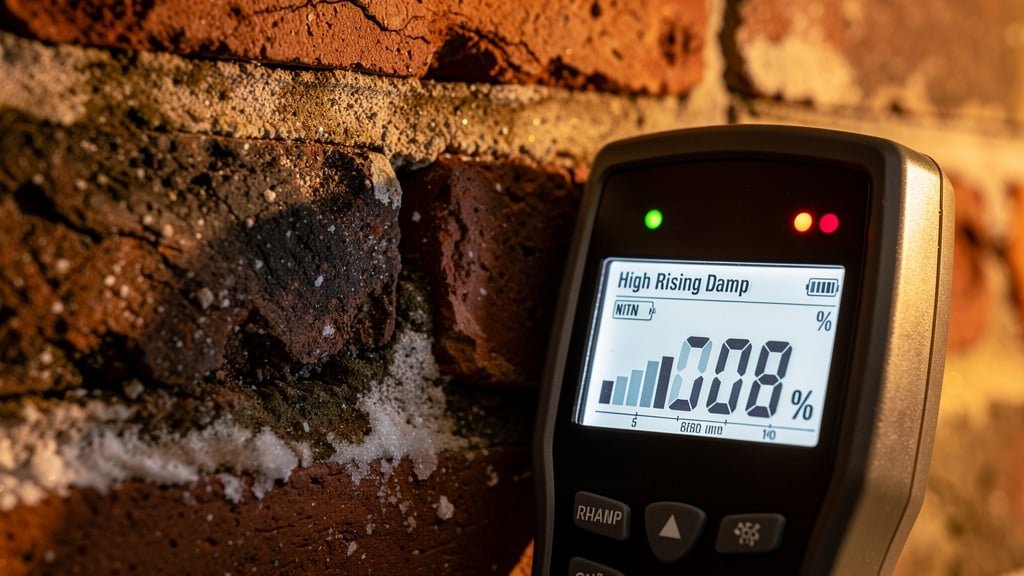
On a survey, we carry a handheld electronic moisture meter — the type that measures electrical resistance in the wall, which rises when moisture is present. We use this as a screening tool throughout the inspection.
But — and this is important — a moisture meter reading alone is not a diagnosis of rising damp. High meter readings can be caused by residual salts from old plaster, metal ties within the wall, foil-backed wallpaper, or a whole range of other factors. A responsible surveyor uses meter readings as a starting point, not a conclusion.
We also look for:
- The characteristic tide mark and salt efflorescence (white, crystalline deposits)
- The pattern and distribution of dampness through the building
- The external ground level relative to the internal floor level
- Evidence of bridging of the original damp-proof course (by render, soil or paving)
- Signs of condensation (which usually affects cold surfaces and corners, not just ground-floor walls)
- Signs of penetrating damp from above (leaking gutters, failed pointing, poor flashings)
The Problem With Damp Surveys from Remedial Contractors
Here's where things can go badly wrong for buyers. It's very common for sellers to obtain a damp survey from a company that also sells damp-proofing treatments. The conflict of interest is significant: a company that makes money treating rising damp has a financial incentive to find rising damp.
I've seen countless examples of damp-proofing reports that diagnose rising damp where I would diagnose condensation or penetrating damp. The prescribed treatment — typically a chemical injection DPC at several thousand pounds — would do nothing to address the actual problem.
This is why it matters enormously that your assessment of damp in a property comes from an independent RICS-accredited surveyor who has no financial interest in recommending a particular treatment. Our Level 3 building surveys give you that independent view.
What Should You Do if Your Survey Identifies Damp?
It depends on the cause and severity. Here's the hierarchy I'd typically recommend:
- Identify the source correctly first. Don't commission treatments until you know what you're treating. We can recommend independent specialists who carry out diagnostic surveys without a commercial interest in the outcome.
- Address obvious bridging issues. If the external ground level is above the DPC, lowering it may be all that's needed. If render is bridging the DPC, removing it at low level can solve the problem for a fraction of the cost of chemical injection.
- Use damp conditions to renegotiate. Our survey report can give you an estimated cost for remediation, which you can use to ask the seller for a price reduction or for them to resolve the issue before exchange.
- Consider traditional lime plasters. In Victorian properties, lime-based plasters are far more effective than modern sand-cement renders in managing residual moisture. A good specialist plasterer can often do more than a damp-proofing contractor.
A Real Case Study from Chiswick W4
A client came to me last spring after receiving a damp survey — commissioned by the seller — that identified "severe rising damp" throughout the ground floor of a Victorian mid-terrace in Turnham Green. The recommended treatment was a chemical injection DPC and full re-plastering to 1.2m height throughout, at a cost of £9,500.
When I carried out the Level 3 survey, I found:
- The external ground level had been raised by a previous owner's landscaping, bridging the original slate DPC by about 150mm
- A section of render on the rear elevation was cracked and was channelling rainwater into the base of the wall
- The "damp" on the internal rear wall was following the pattern of penetrating damp from the render failure, not rising damp
The actual solution? Lower the external soil level (£200 in gardening time), repoint and repair the render (£800), and allow the walls to dry out over 6–12 months. Total cost: around £1,000 rather than £9,500. My client used the report to renegotiate £6,000 off the purchase price.
Summary: What Chiswick Buyers Need to Know About Damp
- Victorian properties commonly have original or failed DPCs — but this doesn't automatically mean they have active rising damp
- True rising damp is less common than the remedial industry suggests
- Always get an independent assessment from a RICS-accredited surveyor before commissioning treatments
- Damp findings can be powerful tools for price negotiation
- A Level 3 Building Survey from Chiswick Surveyors will give you the full, unbiased picture
Related Guides
- Level 2 vs Level 3 Survey: Which Do You Need?
- 5 Damp-Proofing Myths That Cost Homeowners Thousands
- Buying in Bedford Park: A Surveyor's Guide
- Our Level 3 Building Survey service

Sarah Mitchell
RICS-accredited surveyor and registered valuer at Chiswick Surveyors. Over 12 years' experience surveying residential and leasehold properties across West London. Specialises in valuation and damp investigation.